
Building Pinterest from 0→ 1
Context
In 2023, I began and led the development of Herrmann Global's Pinterest advertising program, transforming an untapped platform into a repeatable agency service for destination marketing clients. My work spanned strategy, creative direction, campaign design, performance analysis, and continuous optimization.
This project complements Herrmann Global's published business case study by focusing on my design process and my role in building the program.
project duration
3+ years (ongoing)
My Role
End-to-End Program Designer + Strategist
Areas of Ownership
-
Product Strategy
-
User Research
-
Visual Design
-
UX/UI Design
-
Design Systems
-
Experimentation
-
Performance Analytics
-
Cross-Functional Collaboration
-
AI-Assisted Design
The Challenge
Pinterest was largely unexplored as a paid marketing channel within our agency.
There were no:
-
creative standards
-
workflows
-
campaign structure
-
testing process
-
reporting framework
-
internal documentation
The challenge wasn't simply designing campaigns, it was designing a scalable system that could support multiple destinations while continually improving through experimentation and performance data.
The Process
I approached Pinterest as a product opportunity: By identifying an untapped audience, validating the concept through experimentation, and building a scalable system that evolved through research, design, and performance insights.
1. Identifying the Opportunity
Pinterest was initially a small organic channel within Herrmann Global, but I recognized an opportunity to connect destination brands with a highly engaged audience in a different stage of the travel journey. Unlike traditional social platforms focused on connection and engagement, Pinterest users were actively searching for inspiration, planning future experiences, and saving ideas for later.
Because travel is inherently visual and aspirational, I saw a strong alignment between Pinterest’s user behavior and the stories our brands and clients were already creating. I advocated for expanding Pinterest beyond organic content by presenting the opportunity internally and building support across marketing, client management, and business development teams.

The 1-Sheeter I used to pitch Pinterest ads for clients to the Business Development team.
2. Validating Through Experimentation
Before introducing Pinterest as a client offering, I spent a year testing and refining campaigns for our own brands, starting with Visit USA Parks and later expanding to Untraveled. Using existing editorial content, I developed campaigns around topics designed to inspire exploration, including destination guides, cultural experiences, and outdoor adventures.
These early experiments allowed me to establish benchmarks, understand audience behavior, and validate Pinterest’s potential through measurable results. By analyzing impressions, CTR, CPC, and outbound clicks, I was able to demonstrate the platform’s value and create a data-backed case for expanding Pinterest advertising to clients.


Examples of creative testing results for Visit USA Parks and Untraveled.
3. Building a Scalable Design System
Once Pinterest proved its value, I developed a repeatable framework that allowed us to create consistent, effective campaigns across multiple destinations while maintaining each brand’s identity.
I created flexible Canva templates, established visual guidelines, and developed a streamlined workflow around typography, imagery, branding, and content hierarchy. Through ongoing testing, I discovered that simpler, image-forward creative consistently performed better than text-heavy designs, leading me to refine the system over time.
The goal was to create a scalable approach that balanced efficiency, brand consistency, and creative performance.


Early editions of Visit USA Parks pins: On the left was an organic design from before my addition to the team, and on the right I was testing a different font, and found it to be not-readable enough.
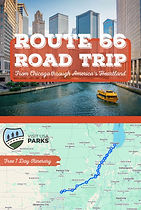


Examples of how the design has evolved with more standard typography, and a healthy layout balance.
4. Measuring, Learning + Iterating
Pinterest became an ongoing cycle of design, testing, and refinement. I developed reporting templates and collaborated with the Head of Digital Marketing to define KPIs that aligned with destination marketing goals, including impressions, CTR, CPC, outbound clicks, and cost-per-thousand metrics.
By continuously analyzing campaign performance, I identified patterns in creative, content, and audience behavior that informed future decisions. These insights influenced not only Pinterest campaigns, but also broader content strategy, including blog topics, social themes, and website updates.


Example of Pinterest segment of a final client report.
5. Scaling the program
What began as an experiment grew into a core agency service used across multiple destination marketing clients. I continued refining the process through hundreds of campaigns, for multiple different brands, and in multiple different languages, adapting creative strategies for different audiences, budgets, and goals.
To date, I have developed and executed more than 400 Pinterest campaigns, helping establish Pinterest as a valuable channel for inspiring travelers and connecting destinations with future visitors.
Designing for Discovery
Designing for Pinterest meant balancing inspiration with clarity. Every creative decision, from the imagery and typography to content hierarchy was guided by how people discover, save, and plan on the platform. Through continuous testing, I refined a visual system that prioritized usability, consistency, and engagement.
Visual System
To create a scalable approach across multiple destination brands, I developed a flexible design system built around consistent typography, imagery, and layout principles. Standardized templates streamlined production while allowing each destination's unique story and personality to shine through.

Designing through Iteration
As campaigns grew, so did my understanding of what resonated with Pinterest users. Performance data consistently showed that simpler, image-forward designs outperformed text-heavy layouts, leading me to refine the visual system over time. These iterative improvements strengthened both creative performance and production efficiency.

→

Example of early Pin design (predating my time at the company):
-
Design feels too busy with text overlaying image, decorative elements, and large, outdated logo.
-
Text feels cramped in boxes.
Example of current design style:
-
Text has room to breathe.
-
Typography flows well together.
-
The image-first design allows the Pin to catch user's eyes.
-
Simplified design stands out in the Pinterest feed.
Results + Impact
What began as an internal experiment evolved into a scalable agency offering, transforming Pinterest from a small organic channel into a core service that helps destination clients reach travelers during the inspiration and planning stages of their journey. Through continuous experimentation, design iteration, and data-informed decision making, the program has grown into an integral part of Herrmann Global's digital marketing strategy.
Impact at a glance
400+
Pinterest campaigns
designed + launched
Global Destinations
Scaled across Visit USA Parks, Untraveled, and client accounts
Core agency Service
Built from the ground up and adopted as a recurring client offering
Business Impact
By validating Pinterest's value through internal testing, I helped expand Herrmann Global's service offerings with a repeatable, scalable advertising program. The framework I developed continues to support campaigns across multiple destination marketing organizations while giving clients an efficient way to connect with travelers earlier in the decision-making process.
Design Impact
Beyond individual campaigns, I established creative templates, reporting frameworks, and iterative design processes that improved consistency, streamlined production, and made campaign optimization an ongoing part of the creative workflow. Insights from Pinterest performance also informed broader editorial planning, website content, and cross-channel marketing strategies.
Key Outcomes
✓ Built Herrmann Global's Pinterest advertising program from concept to implementation.
✓ Created a scalable design and reporting system supporting hundreds of campaigns.
✓ Established Pinterest as a recurring client service and trusted marketing channel.
✓ Used performance insights to continuously improve creative direction and content strategy.
✓ Connected user behavior with business goals through research, experimentation, and iterative design.


Final Takeaways
Key Takeaways
Building Pinterest from the ground up reinforced that successful design is about more than creating polished visuals. It's about understanding people, validating ideas, and designing systems that can evolve over time. By combining user insights, experimentation, and performance data, I was able to transform an idea into a scalable solution that delivered value for both users and the business.
Lessons learned
One of the biggest lessons from this project was that small, intentional improvements often create the greatest long-term impact. Rather than pursuing dramatic redesigns, I learned to treat every campaign as an opportunity to test, learn, and refine. That iterative mindset not only improved creative performance but also strengthened the overall system, making it more efficient, adaptable, and valuable over time.
If I were to continue evolving this work, I would explore more personalized creative experiences, AI-assisted testing workflows, and deeper analysis of user behaviors such as saves and long-term engagement. As Pinterest continues to evolve, I'd be excited to explore how emerging AI tools and personalization can further improve the way people discover and plan meaningful travel experiences.